70 Abandoned Hospital Horror Writing Prompts: Sinister Experiments, Haunted Wards & Medical Nightmares
There is something deeply unsettling about an abandoned hospital. Once a place of healing, its empty corridors, decaying operating theatres and forgotten patient rooms now hold the echoes of suffering, desperation and secrets that were never meant to leave the building. Rusted surgical instruments lie scattered across examination tables, medical records gather dust in locked filing cabinets, and somewhere beyond the peeling walls, something might still be waiting for its next patient.
Abandoned hospitals provide the perfect setting for horror fiction because they transform familiar places of safety into environments of uncertainty, vulnerability and dread. What happened to the patients who never left? Why was an entire psychiatric ward sealed off decades before the hospital closed? What if the experimental treatments recorded in a forgotten doctor's journal were never discontinued? And what happens when someone discovers that the building is not quite as empty as it appears?
These 70 Abandoned Hospital Horror Writing Prompts explore the darkest possibilities of deserted medical institutions, from sinister experiments and unexplained disappearances to supernatural hauntings, psychological breakdowns, disturbing medical discoveries and terrifying encounters with things that should never have survived. Whether you're writing a short horror story, developing a psychological thriller, planning a supernatural mystery or searching for inspiration for your next horror novel, these prompts offer unsettling foundations for original fiction.
Inside this collection, you'll discover chilling plot hooks, sinister story titles, atmospheric opening lines, disturbing endings, mysterious characters, nightmarish hospital settings and cinematic visual prompts. Each idea is designed to encourage you to experiment with different types of fear, develop compelling mysteries and transform the familiar imagery of abandoned hospitals into something uniquely horrifying.
If you enjoy exploring the darker corners of storytelling, visit the Horror Writing Hub for more terrifying writing prompts, unsettling characters, disturbing settings and inspiration for horror fiction. You can also discover unexpected ideas in Horror Story Sparks, or browse the Creative Writing Archive for hundreds of additional prompts, story starters and creative writing resources across different genres.
Some hospitals close because they are no longer needed. Others close because of what happened inside. The most terrifying ones are those that never truly closed at all.
1. Abandoned Hospital Horror Plot Hooks
Abandoned hospitals are filled with possibilities for disturbing discoveries, unexplained disappearances and terrifying secrets. A forgotten medical record might reveal a patient who was never discharged, while a sealed operating theatre could conceal evidence of experiments that continued long after the hospital officially closed. These ten abandoned hospital horror plot hooks are designed to spark original stories, offering unsettling situations that writers can develop into supernatural mysteries, psychological thrillers, medical horror or terrifying tales of survival.
The Last Patient: A demolition crew discovers a hospital room that has been sealed from the inside for forty years. Inside, an elderly woman lies connected to medical equipment that should no longer work. Her chart records a new examination every morning, including one scheduled for tomorrow.
The Discharge List: While exploring an abandoned psychiatric hospital, a documentary filmmaker discovers a register containing the names of every patient ever admitted. The final pages list people who have not yet been born, alongside precise dates of admission and causes of death.
The Experimental Ward: A medical student discovers recordings from a discontinued neurological experiment conducted beneath a rural hospital. The patients were supposedly taught to share consciousness, but the final recording contains twenty-seven voices speaking simultaneously through a single patient's mouth.
The Night Shift: A former nurse receives a letter offering her one final shift at the hospital where she worked thirty years earlier. The building has been abandoned for decades, but when she arrives, every ward is illuminated and the patients seem to recognise her.
The Organ Room: Urban explorers discover a refrigerated storage room containing hundreds of carefully labelled human organs. Every container bears the name of someone currently living in the surrounding town, and the newest specimen was collected only hours earlier.
The Children's Ward: A property developer purchases an abandoned children's hospital and discovers that every room contains an identical drawing of a woman standing beside a bed. As renovations begin, the woman starts appearing in photographs taken by the construction workers, moving closer to the camera each day.
The Missing Floor: Architectural plans reveal that an abandoned hospital once contained thirteen floors, although the building has only twelve. During a storm, an elevator begins operating without electricity, offering access to a floor that does not appear on its control panel.
The Recovery Programme: A journalist investigating an abandoned rehabilitation hospital discovers that its former patients all made miraculous recoveries from terminal illnesses. However, every survivor subsequently disappeared on the anniversary of their discharge, leaving behind medical records describing an entirely different person.
The Surgical Demonstration: A group of medical students breaks into a derelict teaching hospital and discovers a surgical theatre arranged for an operation. A projector begins playing footage of a procedure performed fifty years earlier, but the patient on the operating table is one of the students watching.
The Quarantine Zone: An abandoned infectious disease hospital is scheduled for demolition after decades of isolation. When workers breach a concrete-sealed ward, they discover hundreds of hospital beds arranged around a single empty crib. Every wall is covered with the same warning: Do not let it hear you breathing.
2. Abandoned Hospital Horror Story Title Ideas
A compelling horror title can suggest an entire nightmare before the first sentence has been written. Hospital terminology, medical procedures, institutional records and familiar phrases associated with treatment can become particularly disturbing when placed within an abandoned setting. These ten horror story titles are intended as creative starting points, encouraging writers to imagine the sinister events, unsettling characters and hidden histories that might lie behind each name.
The Patients in Ward Zero — A forgotten hospital ward contains beds assigned to people whose existence has been erased from every official record.
Discharged Against Medical Advice — A former patient returns to the hospital that treated her childhood illness and discovers why the doctors were so desperate to prevent her from leaving.
The Anatomy of Silence — An abandoned surgical research facility holds evidence of an experiment designed to discover whether human consciousness survives the removal of the brain.
Visiting Hours Are Over — Every evening at precisely six, visitors appear outside a deserted hospital carrying flowers for patients who died decades earlier.
The Mercy Procedure — A hospital's experimental pain-relief programme promised to eliminate suffering permanently, but its surviving participants are desperate to feel something again.
Bedside Manner — A disgraced physician's recorded consultations reveal that he continued treating patients long after their deaths.
The Isolation Protocol — A locked psychiatric ward contains instructions for preventing an unidentified condition from spreading through human memory.
The Children's Recovery Room — A former children's hospital contains a recovery room where the toys are older than the building and every patient's name has been scratched into the the walls.
An Unnatural Cause of Death — A pathologist investigating a deserted hospital discovers autopsy reports describing injuries that could not possibly occur inside a human body.
Please Remain in Your Bed — An abandoned hospital's emergency announcement system begins issuing instructions to unseen patients, warning them that leaving their rooms will result in immediate termination.
3. Abandoned Hospital Horror Opening Lines
The opening line of a horror story should create immediate curiosity, establish an unsettling atmosphere or introduce a detail that makes the reader question what is happening. Abandoned hospitals offer countless opportunities for disturbing beginnings, from impossible sounds in empty corridors to medical discoveries that challenge everything a character believes. These ten opening lines are designed to spark different stories, giving writers an intriguing first sentence that can develop into a larger mystery, terrifying encounter or psychological nightmare.
The Waiting Room: The hospital had been empty for thirty-two years, but the ticket machine still dispensed numbers, and mine was next.
The Examination: The first thing I noticed about the body on the operating table was that someone had sewn my childhood birthmark onto its shoulder.
The Nursery: There were eleven empty cribs in the abandoned maternity ward, and every mobile began turning when I whispered my mother's name.
The Patient File: According to the medical records, I had been admitted to St. Agnes Hospital every Thursday for the past sixteen years, although I had never heard of the place.
The Emergency Call: At 3:17 a.m., the disconnected telephone on the abandoned nurses' station rang, and a frightened little boy asked why nobody had come to collect him.
The Observation Window: Behind the reinforced glass, something wearing a hospital gown stood perfectly still, copying my movements three seconds before I made them.
The Autopsy: The corpse was still warm when we found it in the deserted morgue, but the death certificate had been signed in 1964.
The Visitor: My father had been dead for eleven years when I saw him sitting beside a hospital bed, patiently peeling an orange for someone beneath the sheets.
The Treatment: The instructions on the operating theatre wall were written in dried blood, and the final step simply read: Do not put it back.
The Ward: I knew we had entered the wrong hospital when the patients began screaming for us to leave before the doctors discovered we were alive.
4. Abandoned Hospital Horror Closing Lines
The final line of a horror story can transform everything that came before it. A seemingly innocent detail might reveal the true nature of a haunting, a survivor's escape could become something far more sinister, or a disturbing discovery might suggest that the nightmare is only beginning. These ten abandoned hospital horror closing lines are designed to inspire stories that build towards chilling revelations, tragic consequences, psychological uncertainty and endings that linger long after the final page.
The New Admission: When they finally demolished the hospital, the workers found one last patient file beneath the foundations, dated tomorrow and bearing my photograph.
The Operation: I looked down at the neat stitches across my stomach and realised the surgeons had not removed anything. They had made room.
The Escape: Beyond the hospital gates, the town was silent, the streets were empty, and every house had a red cross painted across its front door.
The Night Nurse: She straightened my blanket, checked the monitor and smiled with professional warmth. "There now," she whispered. "You've been dead for years. Isn't it time you stopped pretending?"
The Children's Ward: The last photograph showed the children standing together beneath the hospital sign, each holding a small white balloon. Only when I turned it over did I recognise my own handwriting beneath the words: Our first day here.
The Diagnosis: I burned the records, destroyed the samples and sealed the laboratory door, but that night my daughter woke screaming that she could hear the doctors discussing her treatment through the bedroom walls.
The Visitor's Book: Beneath hundreds of faded signatures, someone had written my name again and again, each entry accompanied by a different date of death.
The Morgue: The mortuary drawer slid shut behind me, and somewhere in the darkness a familiar voice said, "Good. Now we can begin the examination."
The Final Broadcast: As the hospital disappeared behind us, the emergency radio crackled into life. "Attention all staff," announced a cheerful voice. "The missing patient has successfully entered the general population."
The Discharge: I stepped into the sunshine, clutching the discharge papers that proved I was finally free. Across the bottom, in small red letters, someone had stamped: Subject unaware that treatment continues.
5. Abandoned Hospital Horror Character Ideas
The most memorable hospital horror stories are not frightening simply because of their settings. They become terrifying through the people who inhabit them, the secrets those people conceal and the choices they make when confronted with something impossible. An abandoned hospital might attract former employees, grieving relatives, urban explorers, medical researchers or individuals searching for answers about their own past. These ten character ideas introduce distinct personalities, motivations and disturbing circumstances that writers can develop into protagonists, antagonists, unreliable narrators or mysterious figures.
The Nurse Who Never Retired: An elderly former nurse returns to the abandoned hospital every Sunday, dressed in her immaculate uniform and carrying a tray of medication. She insists that her patients are still alive and becomes violently distressed whenever someone attempts to enter the locked intensive care unit.
The Patient Without a Reflection: A young woman discovers that she spent the first seven years of her life inside an experimental psychiatric hospital, although her family claims she was born elsewhere. Since visiting the ruins, mirrors have begun showing her wearing a hospital gown, surrounded by people she cannot see.
The Anatomist's Daughter: A brilliant but socially isolated medical illustrator inherits her father's collection of anatomical drawings. Each illustration depicts a different stage of a surgical procedure performed on the same unidentified patient, whose face becomes increasingly similar to her own.
The Hospital Photographer: A former forensic photographer is hired to document a derelict medical facility before demolition. He discovers that the developed photographs contain additional figures, including a young surgeon who appears to be performing operations on people standing beside him.
The Boy from the Isolation Ward: A pale, barefoot child wanders the grounds of an abandoned infectious disease hospital, asking visitors to help him find his mother. He speaks in an unfamiliar dialect, knows the names of people he has never met and leaves tiny handprints on surfaces that nobody has touched.
The Disgraced Surgeon: A celebrated surgeon whose career ended after a series of unexplained patient deaths returns to his former hospital. He believes the building contains proof of his innocence, but the surgical instruments begin appearing inside his home, arranged beside photographs of his family.
The Woman Who Collects Patient Files: A meticulous archivist spends her weekends rescuing medical records from abandoned institutions. She becomes obsessed with a series of patients who shared identical fingerprints, handwriting and facial features despite being admitted decades apart.
The Last Security Guard: A night security guard has protected a deserted hospital for twenty years, refusing promotions, holidays or retirement. He carries a handwritten list of rules and knows exactly which doors must remain locked, but recently he has begun forgetting why.
The Grieving Father: A widowed father breaks into the hospital where his daughter died during an experimental treatment. He discovers a series of recordings in which she describes growing older, attending school and eventually becoming a mother, although the tapes were made after her death.
The Volunteer Patient: A desperate young man agrees to participate in an experimental treatment advertised through an anonymous online forum. He arrives at an abandoned hospital expecting a secret medical trial, only to discover that the other volunteers have been living inside the building for years and no longer remember what they volunteered for.
6. Abandoned Hospital Horror Setting Ideas
An abandoned hospital can become a character in its own right. Its architecture, medical equipment, institutional history and physical decay can create an atmosphere of claustrophobia, isolation and dread before anything supernatural occurs. From underground operating theatres and flooded psychiatric wards to forgotten children's hospitals and remote quarantine facilities, these ten abandoned hospital settings are designed to inspire stories rooted in different environments, histories and types of fear.
The Underground Surgical Theatre: Beneath a condemned Victorian hospital lies a circular operating theatre accessible only through a concealed staircase. The observation gallery contains rows of numbered chairs, the surgical table is covered in deep scratches, and a series of narrow drainage channels leads towards a locked chamber beneath the floor.
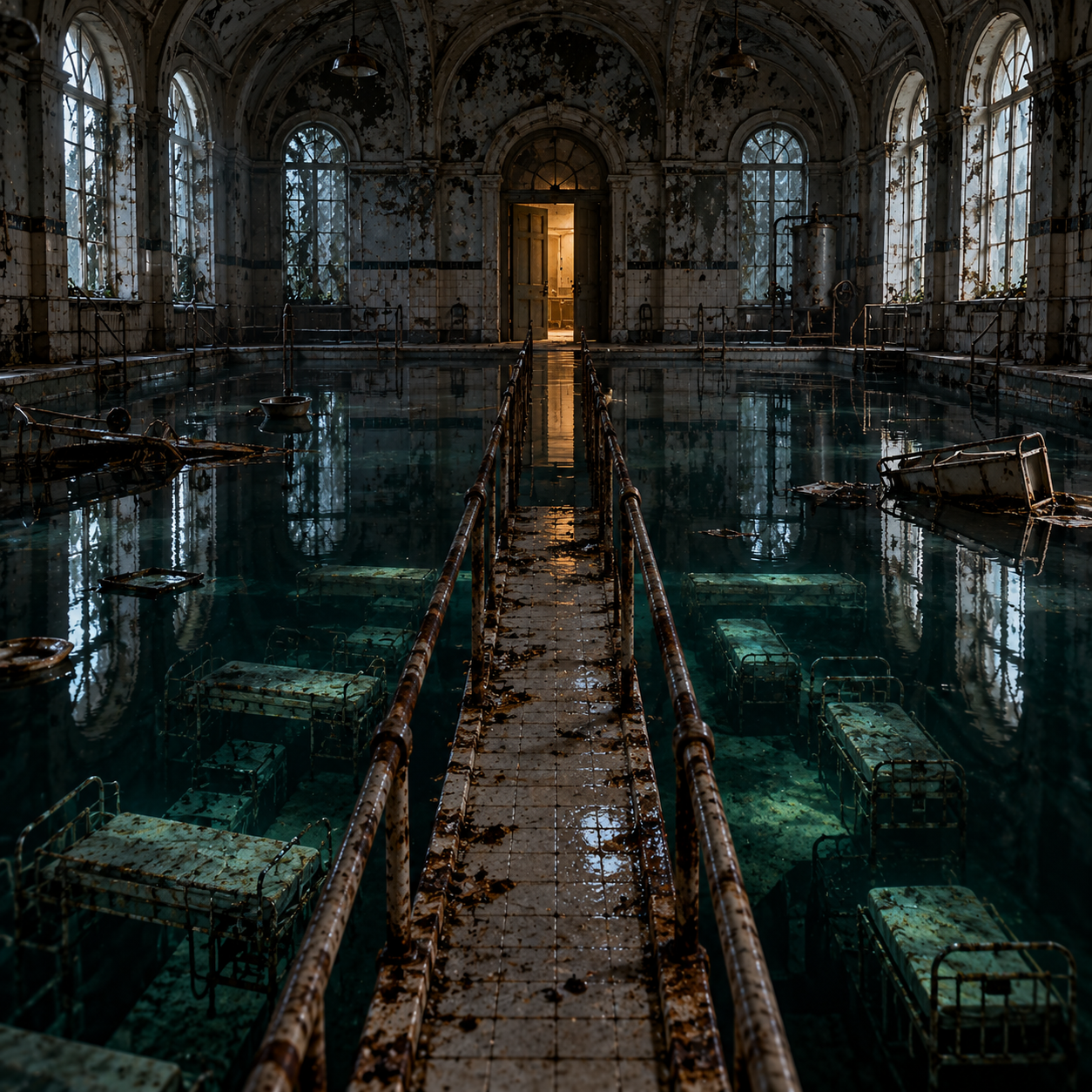
The Flooded Psychiatric Wing: The lowest level of an abandoned psychiatric hospital has been submerged for decades. Patient beds drift beneath the surface, faded treatment schedules remain pinned to the walls, and a submerged corridor leads towards a reinforced door marked Hydrotherapy Research Unit.
The Children's Tuberculosis Sanatorium: High in a remote mountain range stands a deserted children's hospital, its open-air sleeping balconies overlooking miles of dark pine forest. Small shoes remain beneath rusted beds, faded murals depict smiling animals, and the walls of one isolation room are covered in drawings of the same enormous figure standing among the trees.
The Maternity Ward Beneath the Chapel: An abandoned religious hospital contains a maternity ward hidden beneath its chapel. Rows of antique bassinets surround a stone baptismal font, devotional paintings have been turned towards the walls, and a narrow corridor connects the nursery to a sealed crypt.
The Hospital on the Tidal Island: A former infectious disease hospital occupies a small island accessible by a narrow causeway at low tide. Its wards overlook a windswept cemetery, the lighthouse has been extinguished for decades, and the original quarantine bell remains suspended above the harbour.
The Observation Tower: At the centre of a derelict psychiatric institution stands a cylindrical observation tower surrounded by windowless treatment rooms. Every room contains a single chair facing a two-way mirror, and the tower's uppermost chamber is lined with hundreds of tiny viewing apertures.
The Abandoned Emergency Department: A sprawling urban hospital's emergency department remains almost perfectly preserved despite decades of neglect. Wheelchairs crowd the reception area, abandoned ambulances fill the underground garage, and the triage board displays a list of patients whose arrival times are still counting upwards.
The Pathology Museum: Hidden within an abandoned teaching hospital is a vast medical museum containing preserved specimens, wax anatomical models and glass cabinets filled with unusual surgical discoveries. The collection's oldest exhibit is concealed behind a heavy curtain, and its catalogue lists no date, diagnosis or human donor.
The Forest Rehabilitation Hospital: A deserted rehabilitation hospital stands deep within an overgrown forest, connected to a network of therapeutic walking paths and outdoor treatment shelters. Every path eventually returns to the same locked ward, regardless of which direction visitors travel, and the trees surrounding the building have grown around hundreds of discarded hospital identification bracelets.
The Quarantine Hospital Beneath the City: Beneath a modern shopping district lies a forgotten underground hospital constructed during an epidemic. Its narrow corridors contain sealed isolation chambers, decontamination showers and emergency incinerators. A wall of reinforced glass separates the treatment area from a vast chamber filled with hospital beds, all facing an enormous observation window.
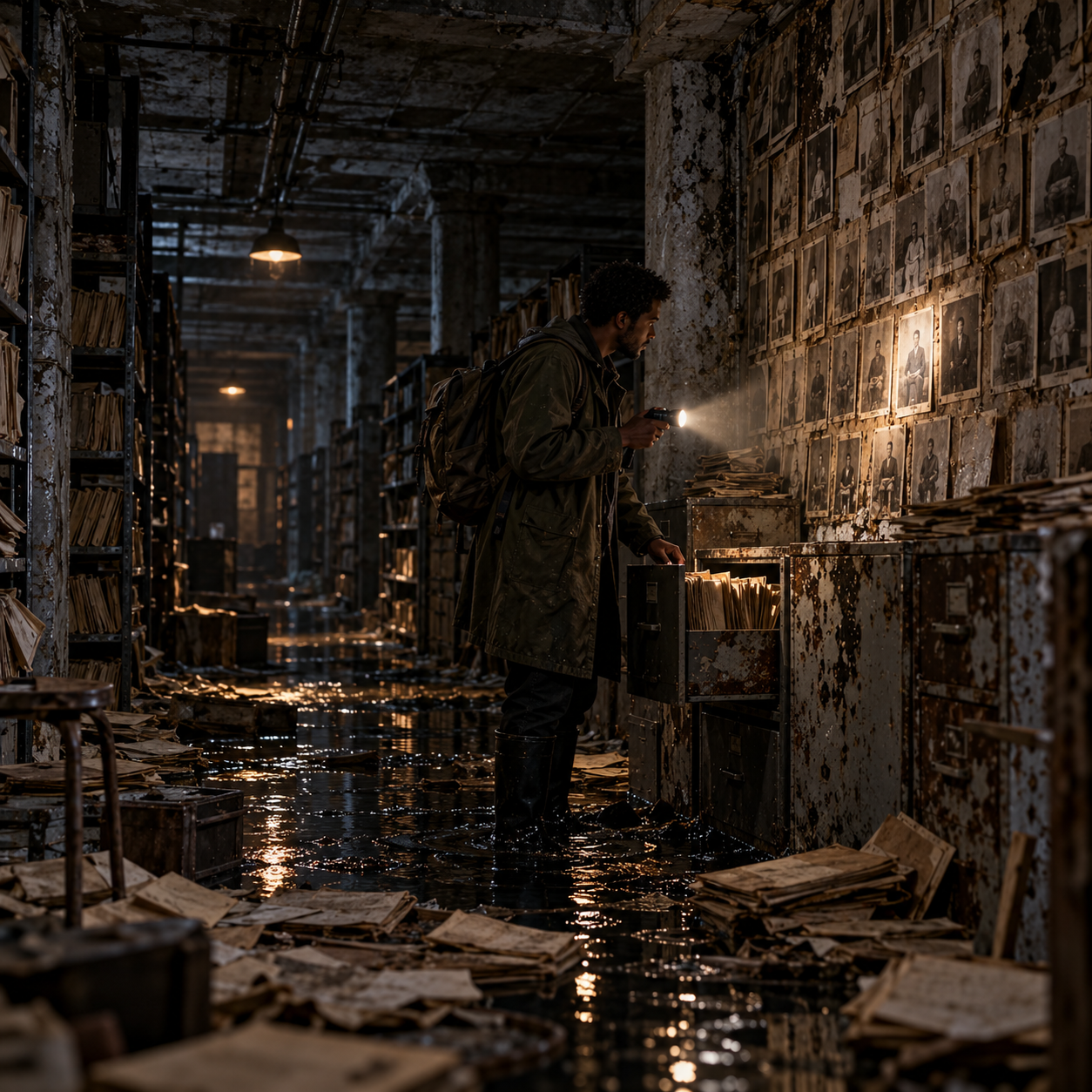
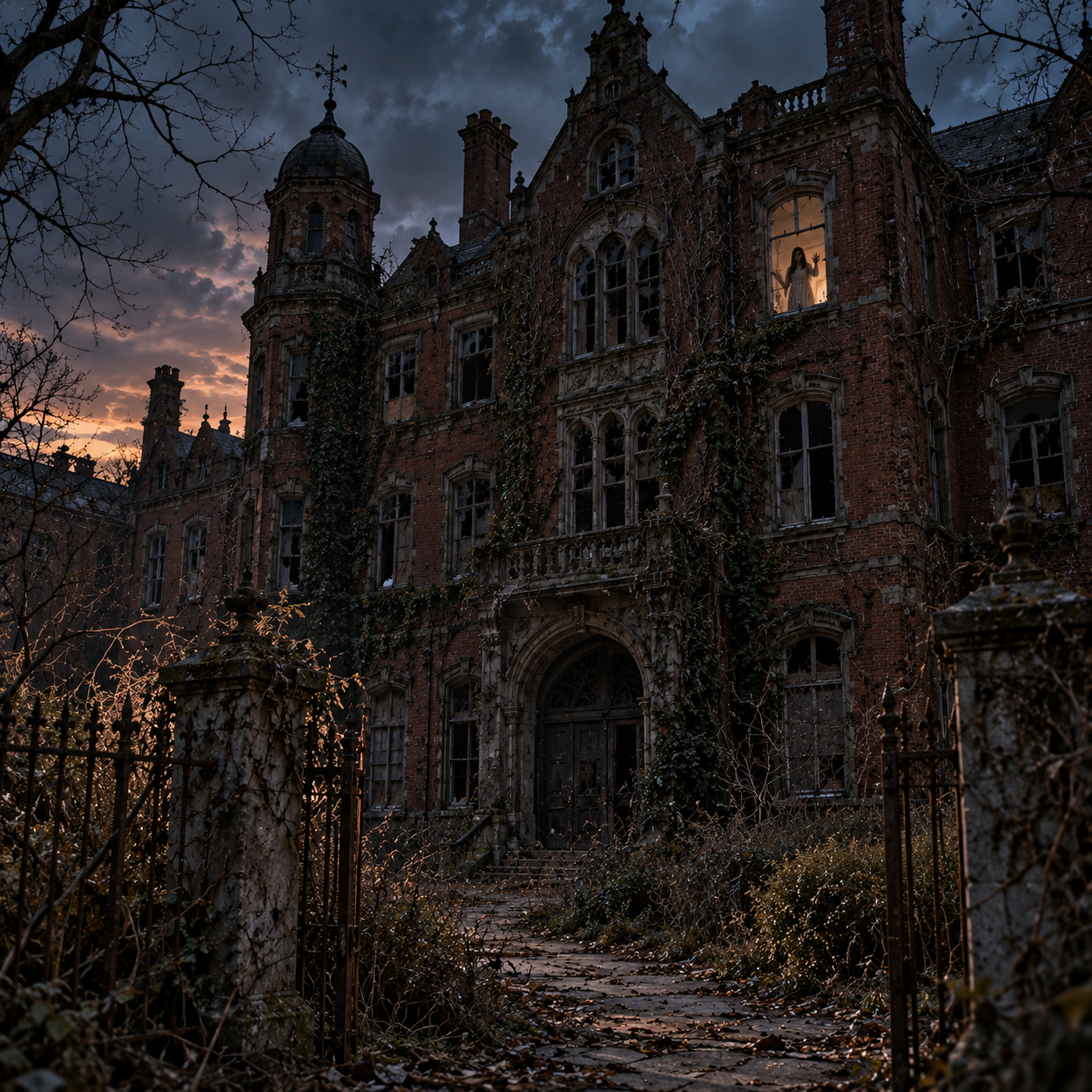
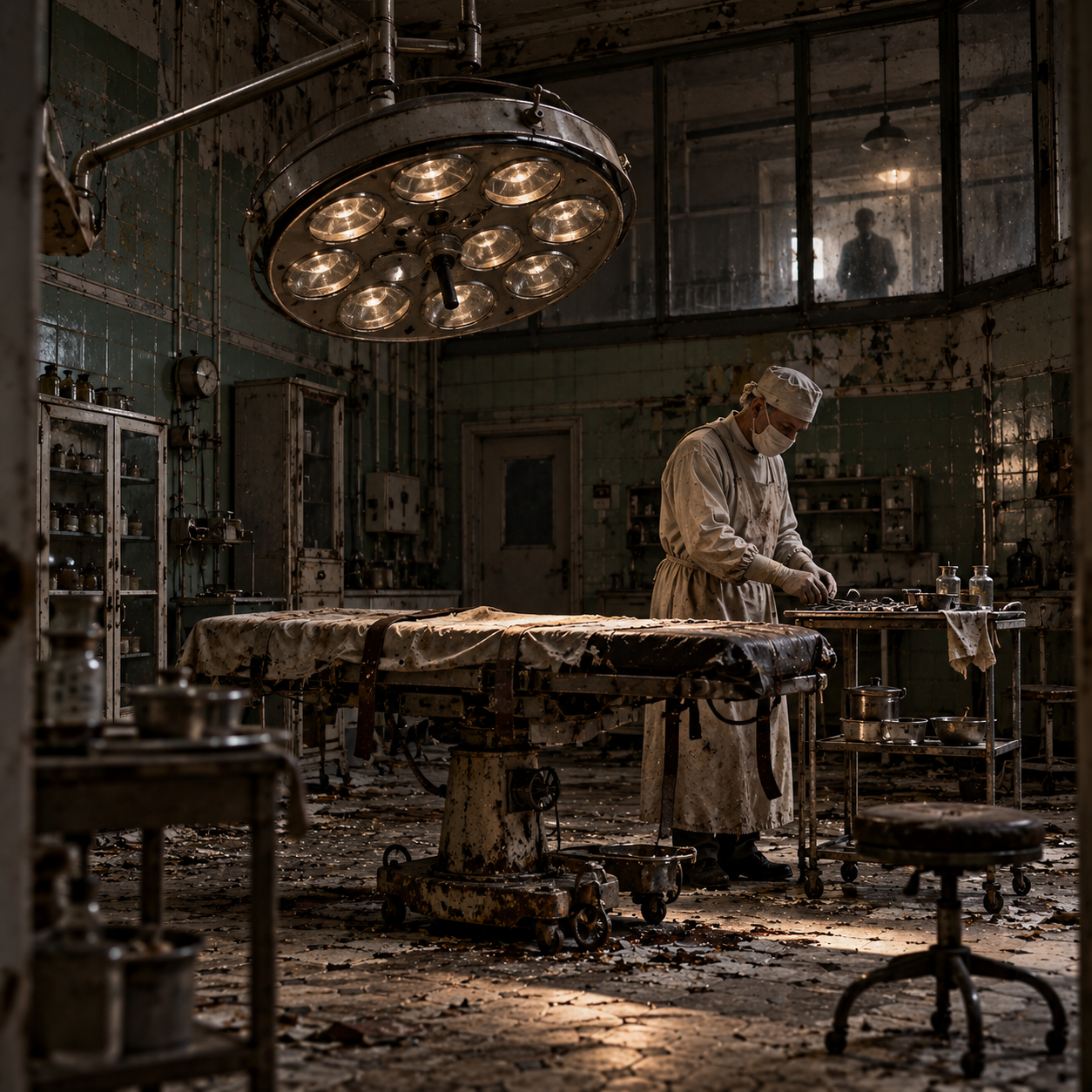
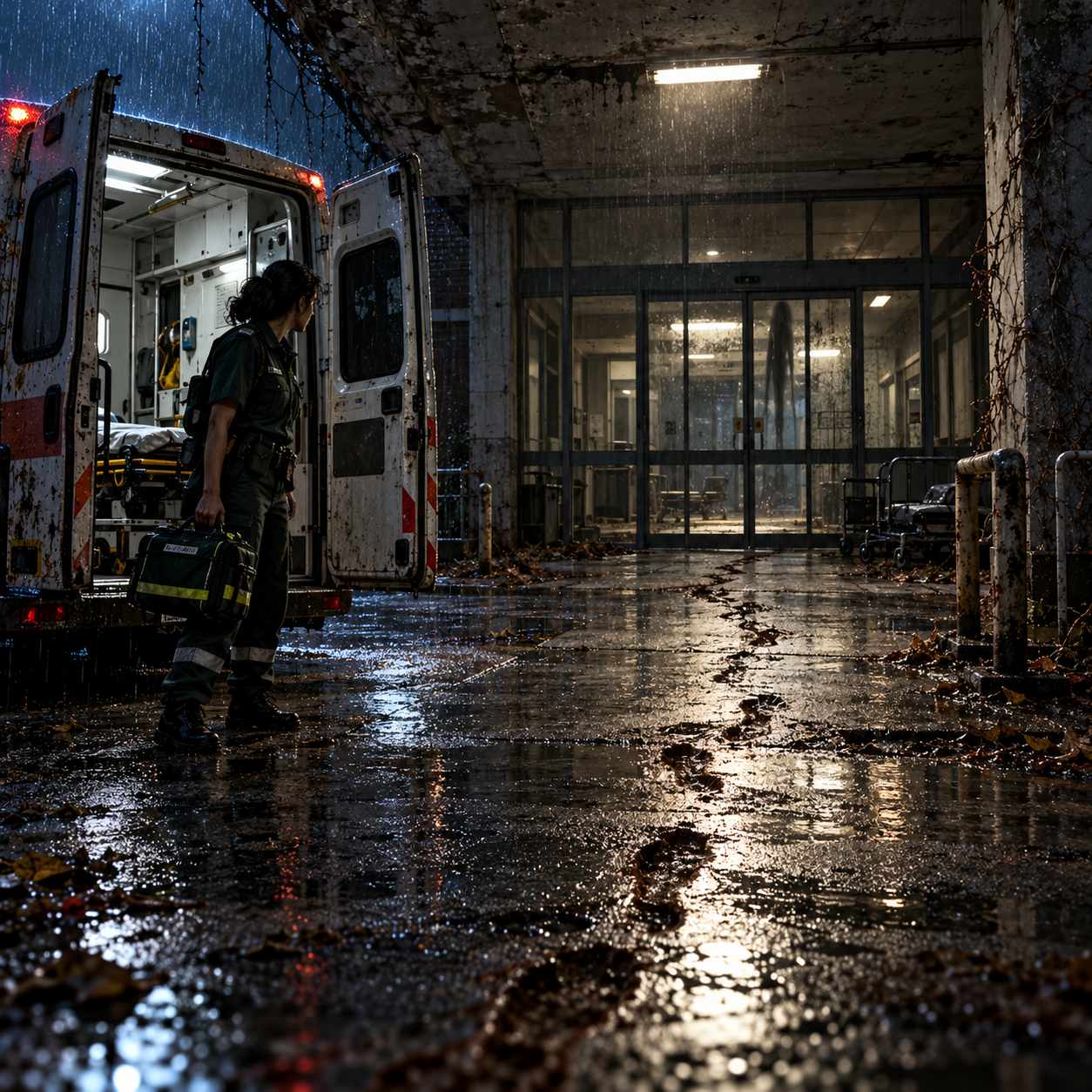
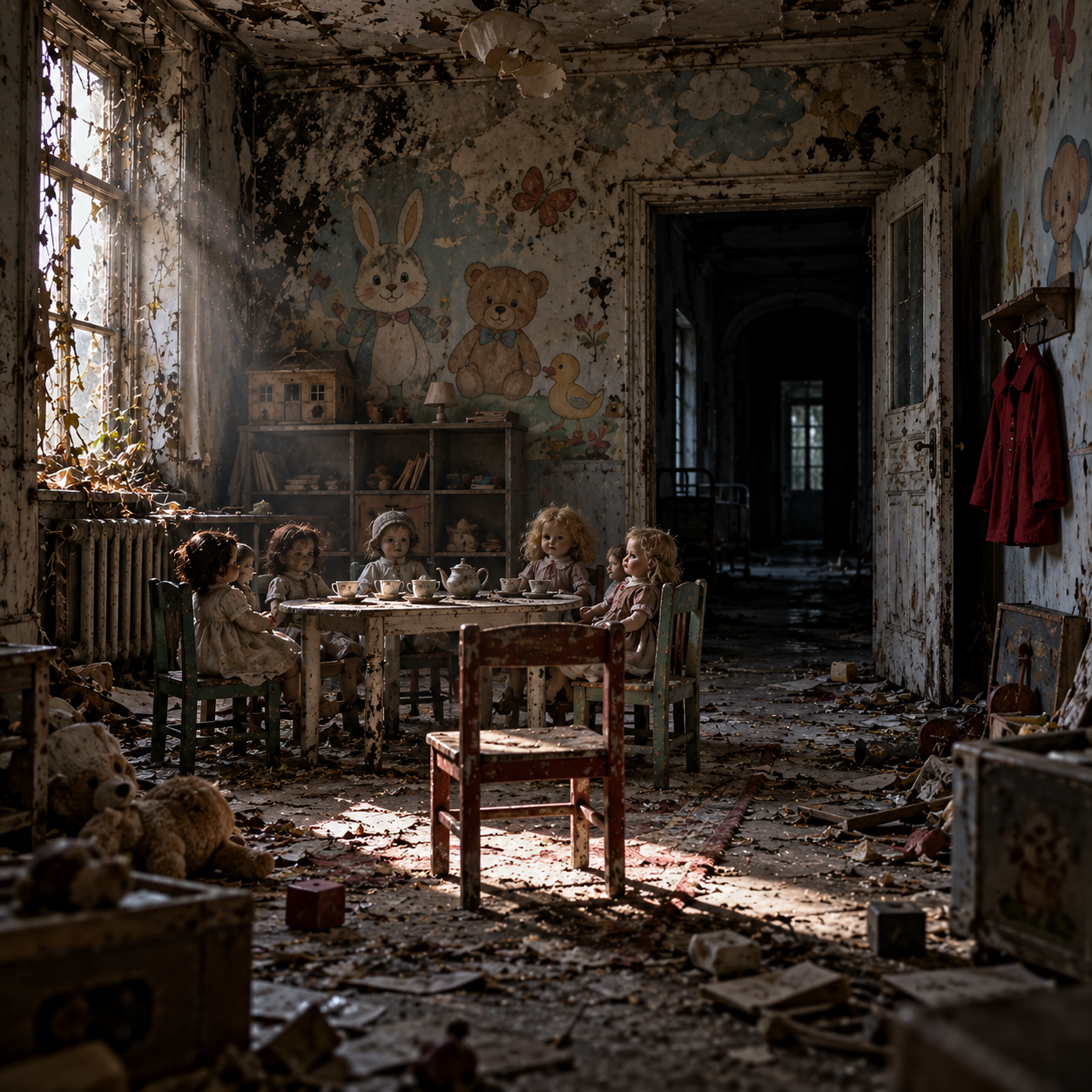
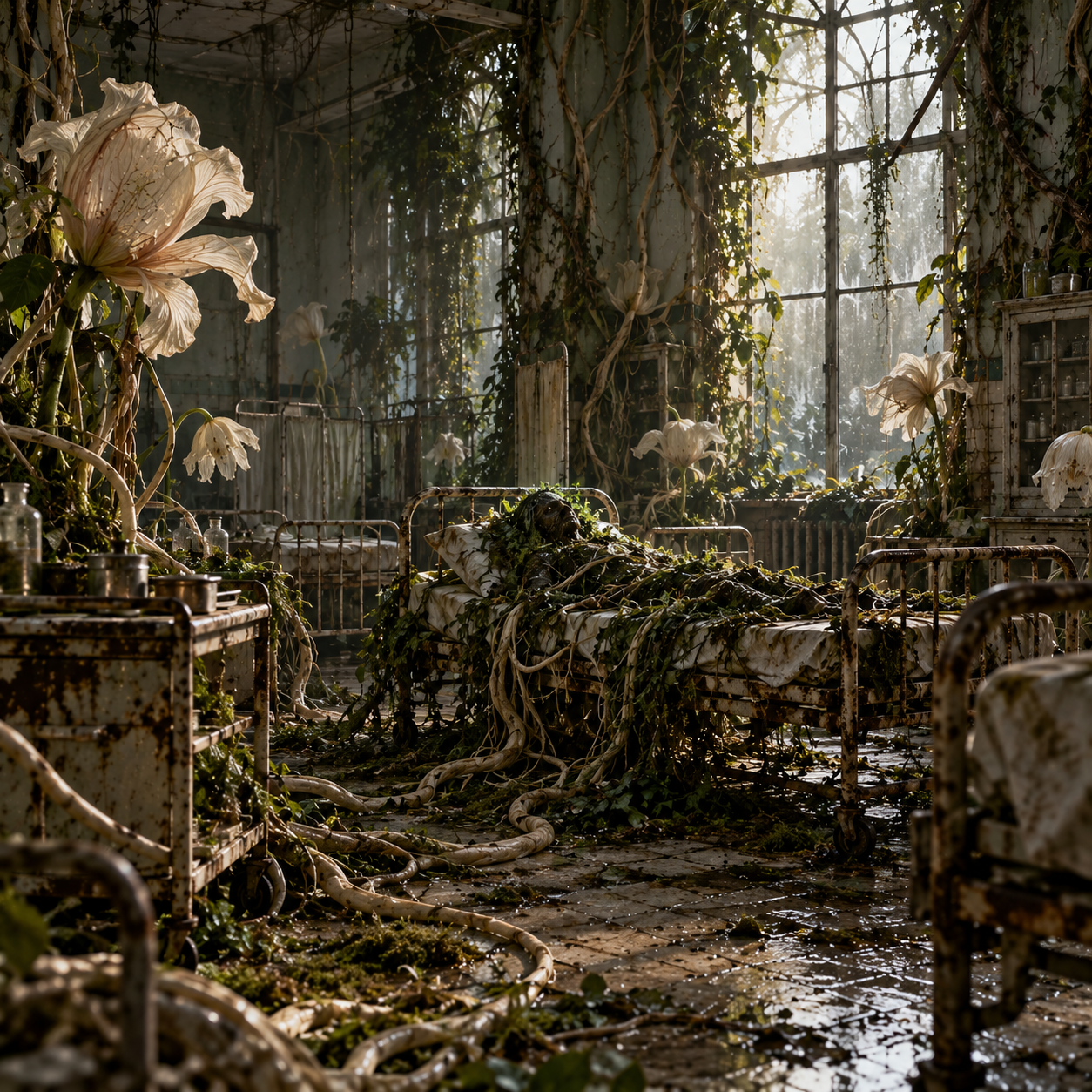
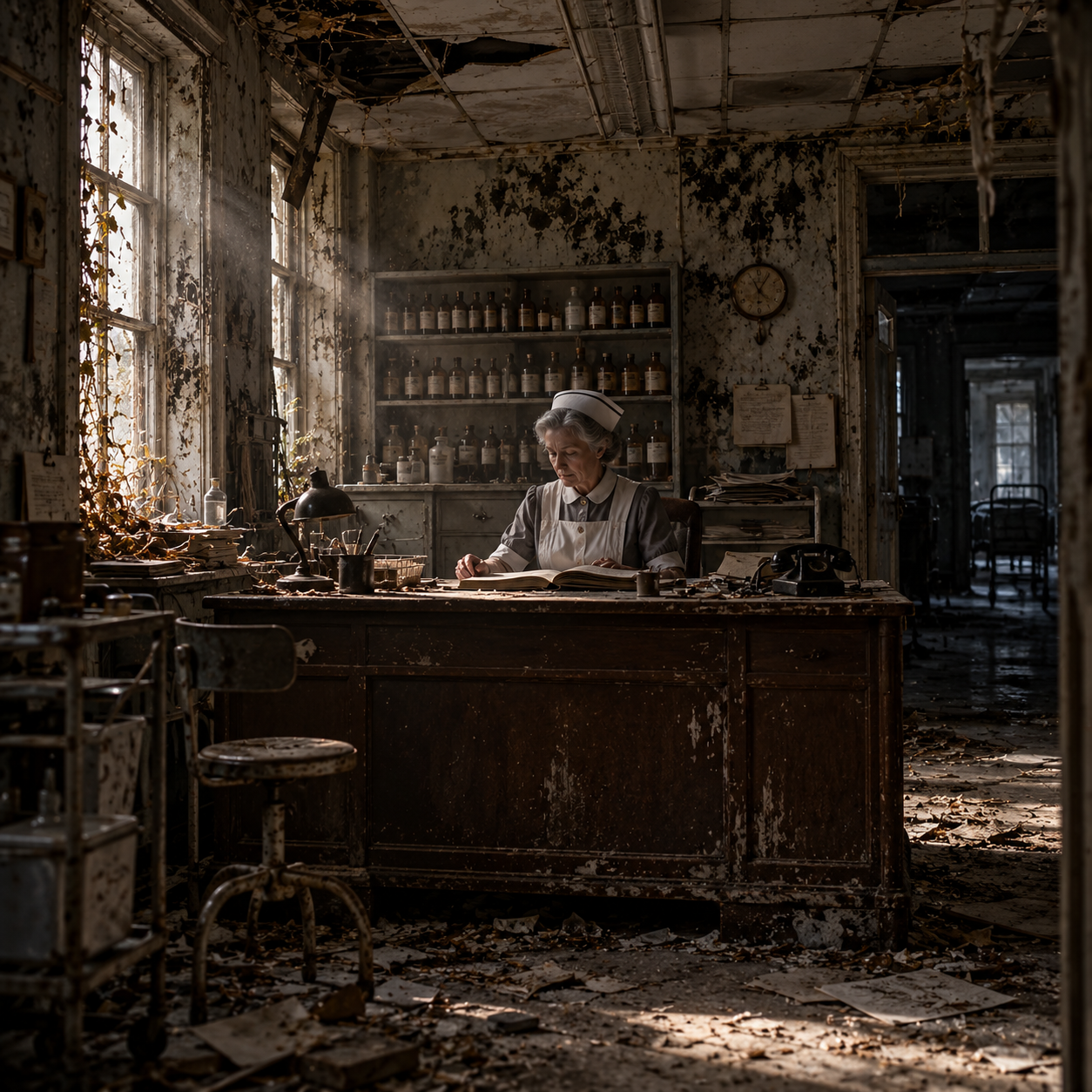
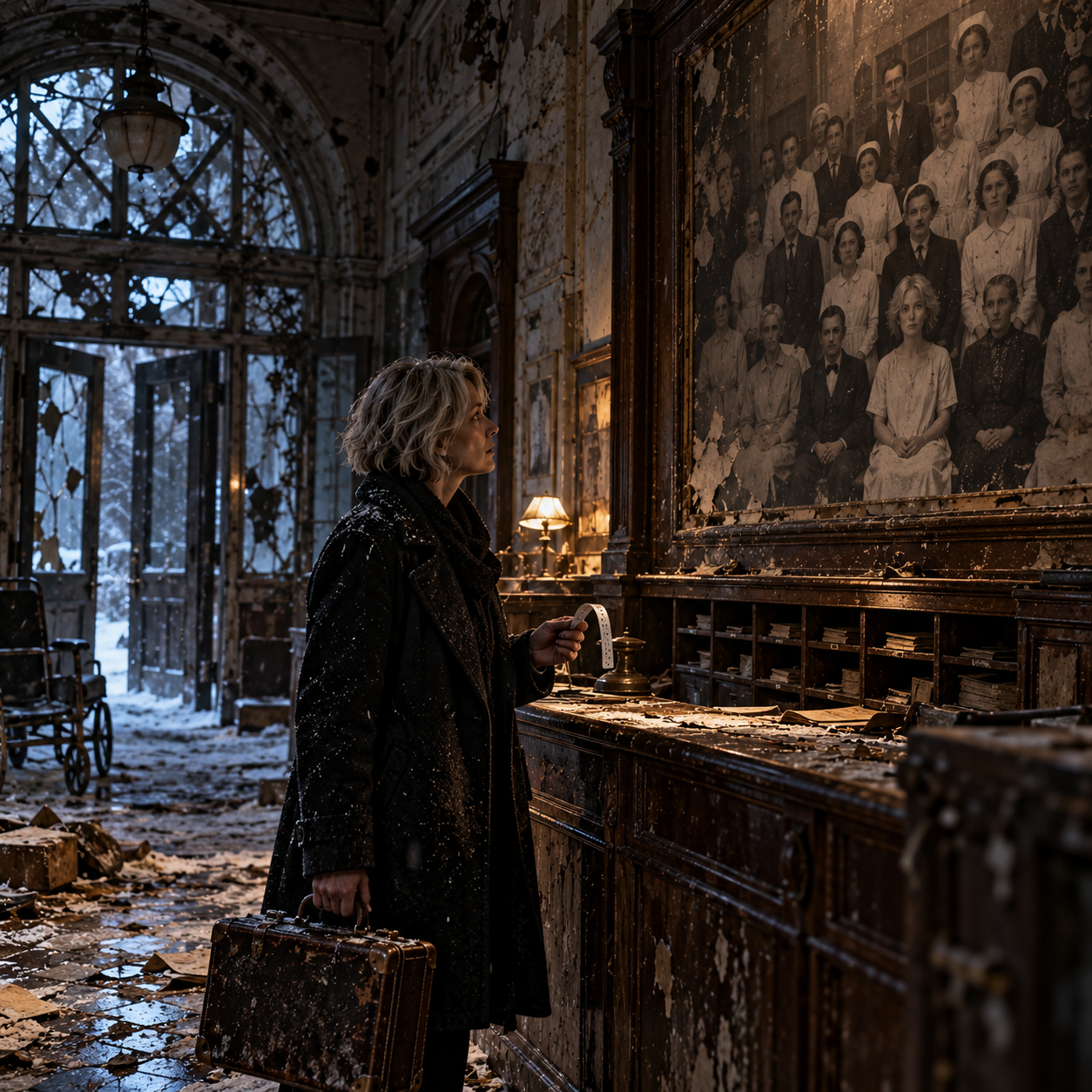
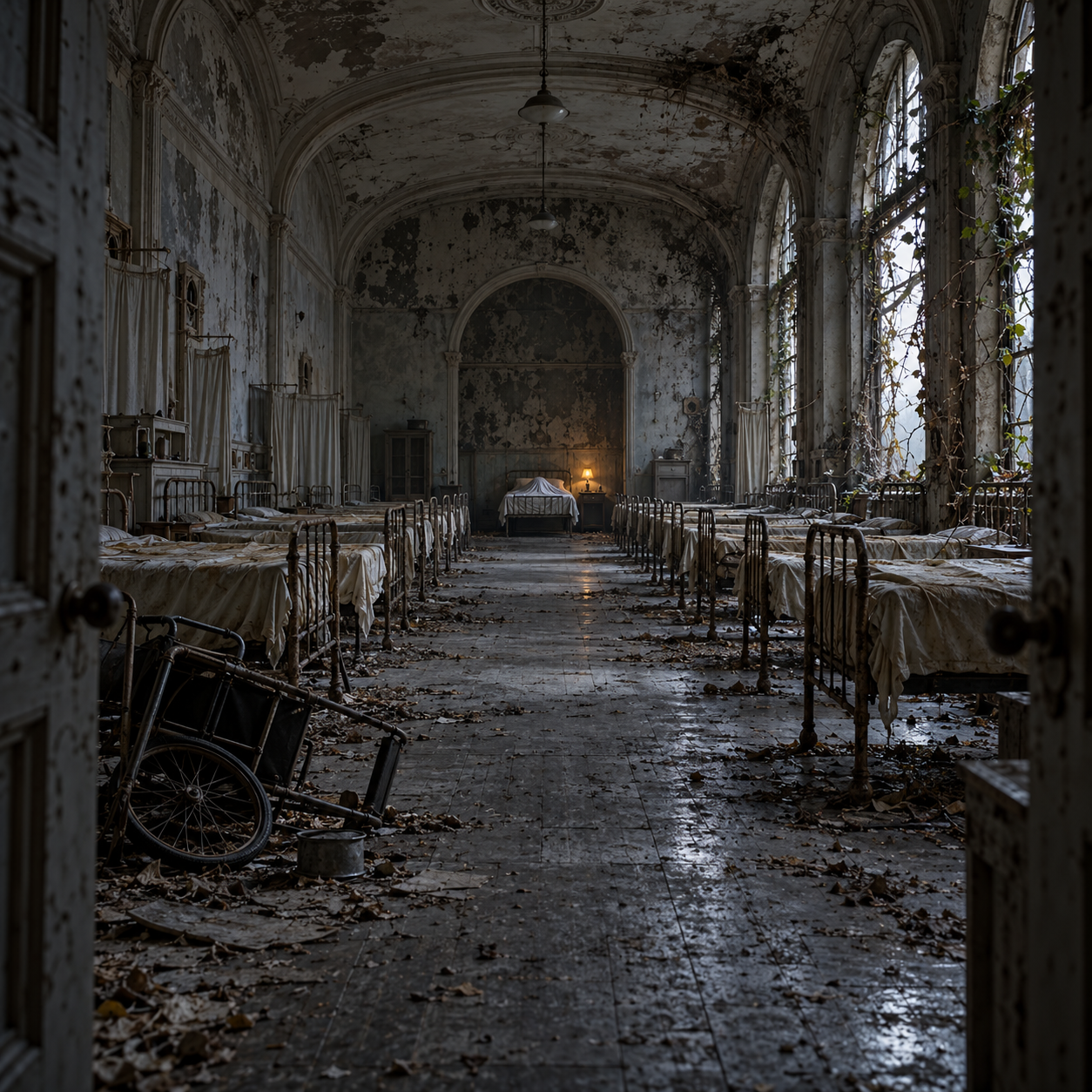
7. Abandoned Hospital Horror Picture Prompts
Sometimes the most disturbing horror stories begin with a single image. An abandoned wheelchair positioned beneath a surgical light, a mysterious figure standing at the end of a flooded corridor or a forgotten patient room filled with impossible objects can raise questions that demand a story. Visual writing prompts encourage writers to explore atmosphere, develop characters, imagine hidden histories and transform unsettling details into original narratives.
The following ten abandoned hospital horror picture prompts use cinematic imagery to spark ten completely different stories. Rather than prescribing a particular plot or explanation, each image invites you to investigate what might have happened, who might be involved and what terrifying secrets could be waiting beyond the frame.
Edinburgh, 1828.
The dead were not always permitted to rest in peace.
As the demand for human bodies grew in Edinburgh's anatomical schools, a shadowy trade flourished among graveyards, burial grounds and the narrow closes of the Old Town.
Graves were disturbed.
Bodies disappeared.
Anatomists paid handsomely for specimens whose origins were seldom questioned.
And some of those who entered the anatomy rooms may never have belonged there at all.
A gold mourning ring containing a lock of dark hair, recovered from the possessions of an Edinburgh anatomy lecturer.
A fragment of Blackwood family tartan, believed to have come from the workshop of disgraced coffin makers implicated in the resurrection trade.
A gravekeeper's lantern fitted with an unusual green glass panel, possibly used to signal when a churchyard was safe to enter.
A silver pocket watch stopped at 3:17, concealing a bloodstained fragment of linen.
A glass specimen jar containing a preserved human hand, with a mysterious red thread tied around its little finger.
A pair of tiny coffin shoes, never worn, containing a lock of golden hair and the name of a six-year-old girl.
A plaster death mask of an unidentified young woman, bearing a chilling inscription:
She was breathing.
And a fragment of coffin lid, its inner surface covered in scratches suggesting that someone had desperately tried to escape.
Some objects were recovered from burial grounds.
Others passed through the hands of undertakers, anatomists and private collectors.
A few were discovered in places where they had no reasonable business being.
And not every person associated with these curiosities can be accounted for.
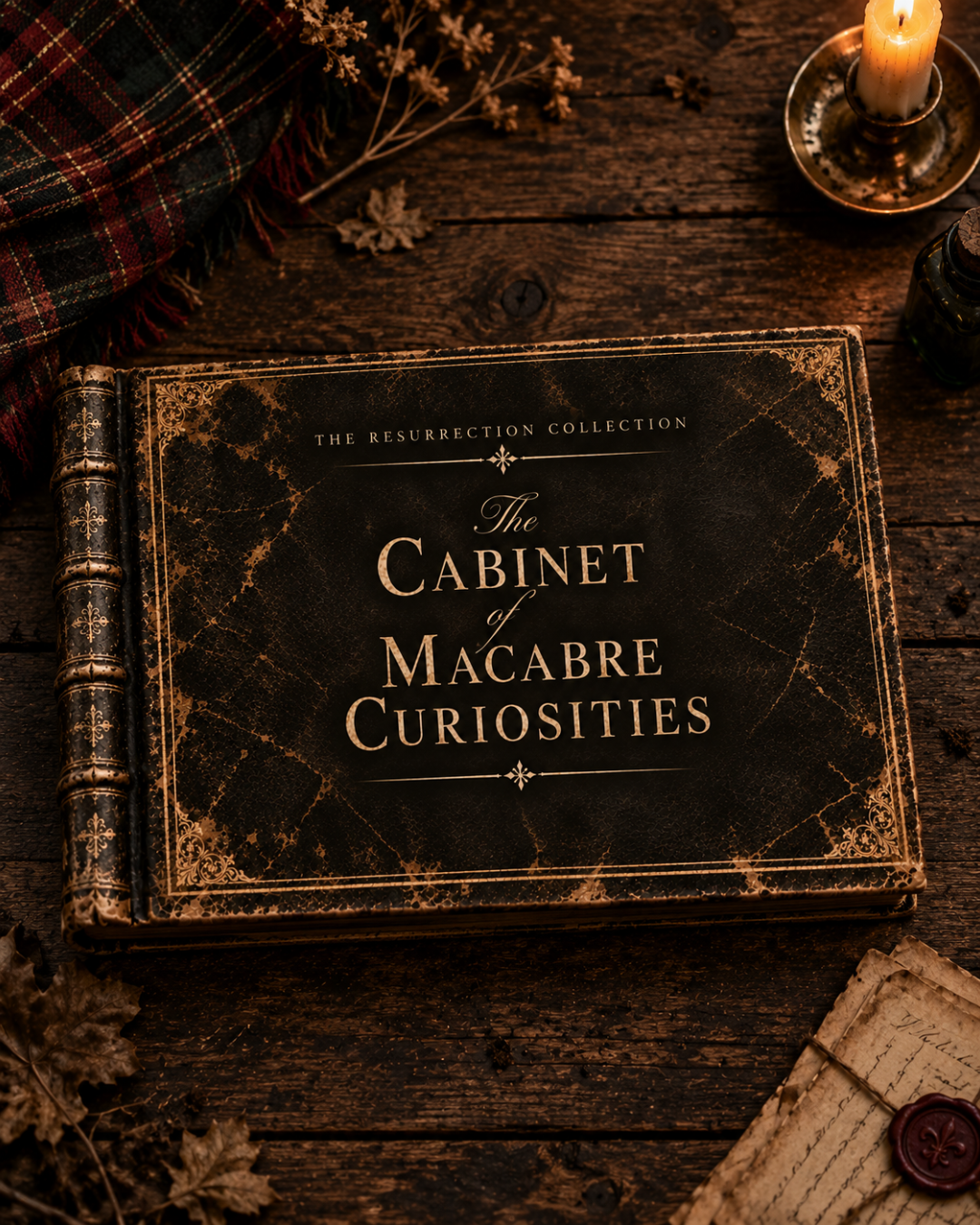
The Resurrection Collection: The Cabinet of Macabre Curiosities is an immersive, beautifully illustrated catalogue of disturbing artefacts, forgotten possessions and mysterious discoveries inspired by Edinburgh's notorious nineteenth-century resurrection trade.
Drawing upon the history of body snatching, Georgian burial customs, anatomical medicine, the darker corners of Edinburgh's Old Town and the unsettling possibilities of Gothic fiction, this fictional archive brings together thirteen macabre curiosities, detailed collector's records, atmospheric archival illustrations and fragments of histories that refuse to remain buried.
Each artefact offers a glimpse into a forgotten life.
Or perhaps a forgotten crime.
Why was a piece of Blackwood tartan recovered from a disgraced coffin-making workshop?
Who carried the gravekeeper's lantern, and what did its unusual green glass signify?
What was concealed inside the anatomist's whisky bottle?
Who was the woman whose hand was preserved in a specimen jar?
Why were a child's coffin shoes kept among an undertaker's possessions?
And who carved the words She was breathing into the back of a death mask?
There are no definitive explanations.
No complete records.
No certainty that every person declared dead had truly died.
Only curious possessions, disturbing discoveries and fragments of Edinburgh's darkest histories waiting to be investigated.
What's Inside?
◆ 13 beautifully illustrated macabre curiosities, each with its own mysterious history, unsettling details and circumstances of acquisition
◆ The collector's introductory letter, introducing a private collection of objects associated with Edinburgh's resurrection trade and anatomical history
◆ Detailed artefact catalogue pages featuring atmospheric hand-drawn illustrations, historical-style descriptions, provenance records and curious observations
◆ Unsettling historical objects, including mourning jewellery, burial relics, grave-robbing equipment, anatomical specimens, medical instruments and mysterious personal possessions
◆ Three illustrated curiosity collections, featuring weathered coffin plates, rusting undertaker's fittings and delicate mourning relics
◆ Atmospheric archival-style illustrations, depicting Edinburgh's graveyards, anatomical theatres, coffin workshops, resurrection men and unidentified individuals
◆ An illustrated collector's inventory, documenting additional anatomical curiosities, mysterious possessions and objects associated with the resurrection trade
◆ Creative writing activities and exploration guidance to inspire historical fiction, Gothic horror, dark mysteries and imaginative investigations
◆ Instant digital download in printable PDF format
Who Is It For?
Perfect for:
◆ Historical fiction writers fascinated by nineteenth-century Edinburgh and its darker history
◆ Gothic horror writers and dark fiction enthusiasts
◆ Lovers of macabre history, grave-robbing mysteries and unusual historical discoveries
◆ Novelists, short-story writers and creative storytellers
◆ Teachers looking for atmospheric visual writing prompts and imaginative historical fiction resources
◆ Fans of anatomical museums, Victorian and Georgian curiosities, and historical mysteries
◆ Mystery and thriller writers seeking unusual clues, suspicious characters and forgotten crimes
◆ Worldbuilders, journalers and solo roleplayers
◆ Lovers of antique collections, cabinets of curiosities and mysterious artefacts
◆ Anyone who enjoys uncovering the disturbing stories hidden inside ordinary-looking possessions
What Makes This Different?
This isn't a traditional collection of writing prompts.
It's a cabinet of objects recovered from a world in which the boundaries between medicine, commerce, death and criminality were dangerously blurred.
Every curiosity suggests a former owner, a questionable transaction, a forgotten incident or a mystery that was never satisfactorily resolved.
But the surviving records are incomplete, the provenance is frequently uncertain, and several objects contain details that raise more questions than they answer.
Examine the Blackwood mourning plaid and consider what happened inside the workshop of the disgraced coffin makers.
Investigate the gravekeeper's lantern and imagine the secret arrangements that might have existed between watchmen and resurrection men.
Study the anatomist's pocket watch and the bloodstained linen concealed inside its case.
Explore the specimen jar and imagine the identity of the woman whose hand was preserved.
Inspect the child's coffin shoes and consider why they were never worn.
Examine the plaster death mask and its terrible inscription.
Study the scratched coffin lid and decide whether its occupant was buried alive, transported while still breathing or the victim of something even more sinister.
Perhaps the lantern was simply an ordinary gravekeeper's possession.
Perhaps the watch belonged to an innocent medical gentleman.
Perhaps the child's shoes were never intended for a burial.
Perhaps the scratches inside the coffin were made long after its original occupant had been removed.
Or perhaps the resurrection trade concealed crimes far more disturbing than the theft of the dead.
You decide what these curiosities mean.
Use the collection to inspire a historical Gothic short story, develop a murder mystery set in Georgian Edinburgh, create a fictional anatomist or resurrection man, or imagine the lives of those whose possessions survived long after their disappearance.
Follow the provenance.
Examine the evidence.
Question the surviving accounts.
Explore the shadowy closes, crowded anatomy rooms and neglected burial grounds of nineteenth-century Edinburgh.
Imagine the secrets that were buried alongside the dead.
And consider what might happen when those secrets are unearthed.
The dead cannot tell their stories. But what if some of them were never dead at all?
Digital download: An illustrated 21-page PDF collection designed in A4 landscape format, featuring thirteen individual macabre curiosities and additional archival material. No physical product will be shipped.
Unearth the Darker Side of Medical History: The Cabinet of Macabre Curiosities
What if the most disturbing stories in medical history were hidden inside the objects people left behind?
Long before modern medicine, the boundaries between scientific discovery, human suffering and criminality were dangerously blurred. In nineteenth-century Edinburgh, anatomists required bodies for medical research, resurrection men disturbed freshly dug graves, and some unfortunate individuals may have entered the anatomy rooms before their lives had truly ended.
Resurrection: The Cabinet of Macabre Curiosities invites you into this unsettling world through an immersive collection of illustrated artefacts, mysterious possessions and forgotten histories inspired by Edinburgh's notorious resurrection trade.
Imagine discovering a plaster death mask bearing the words She was breathing. Who was the woman? Why was her death recorded? And who knew the terrible truth?
Or consider a preserved human hand with red thread tied around its little finger, a silver pocket watch concealing bloodstained linen, or a fragment of coffin lid scratched from the inside.
Each object offers the beginning of a different nightmare.
Unlike conventional horror writing prompts, this beautifully illustrated digital cabinet encourages you to become an investigator, examining mysterious evidence, questioning incomplete records and imagining the people whose stories have been lost.
Inside the 21-page collection, you'll discover thirteen macabre curiosities, atmospheric illustrations, collector's records, an illustrated inventory and creative writing guidance designed to inspire Gothic horror, historical mysteries and dark fiction.
It's particularly suited to writers fascinated by abandoned hospitals, anatomical experiments, disturbing medical discoveries and the unsettling history of medicine.
Use a single artefact to inspire a short story, connect several objects into a larger mystery, or develop an entire fictional world around the secrets of nineteenth-century Edinburgh.
Explore Resurrection: The Cabinet of Macabre Curiosities and discover the stories that refuse to stay buried.
Because sometimes the most horrifying medical discoveries aren't found inside the hospital. They're found in what the doctors tried to hide.

Go Deeper: How to Write a Terrifying Abandoned Hospital Horror Story
An abandoned hospital offers far more than a collection of dark corridors, rusted surgical instruments and empty patient beds. Its real storytelling potential lies in the contradiction between what a hospital is supposed to represent — healing, protection, scientific knowledge and human care — and what happens when those promises are broken.
The most effective abandoned hospital horror stories use their setting to create vulnerability, uncover disturbing histories and challenge a character's understanding of safety, identity and reality. Whether you're developing a supernatural haunting, a psychological nightmare or a story about medical experimentation gone horribly wrong, the following techniques can help transform an unsettling location into a genuinely terrifying narrative.
1. Turn a Place of Healing into a Place of Fear
Hospitals are associated with care, treatment and recovery, but they are also places where people experience pain, uncertainty, helplessness and loss of control. Horror writers can exploit this contradiction by gradually revealing that the institution intended to protect its patients was actually responsible for their suffering.
Consider a hospital where patients were deliberately misdiagnosed, an experimental treatment facility that concealed its failures, or a psychiatric institution where inconvenient individuals were admitted and never released.
The horror becomes particularly effective when familiar symbols of medical care acquire sinister meanings. A nurse's reassuring smile might conceal a threat, a patient identification bracelet could become evidence of imprisonment, and an ordinary consent form might reveal something a character never agreed to.
Try this: Create a hospital with an apparently compassionate mission. What terrible secret lies behind its reputation, and who has the most to lose if that secret becomes public?
For further inspiration, explore Psychological Horror Writing Prompts for stories involving manipulation, unreliable perception and the terrifying loss of personal autonomy.
2. Use Medical Horror and Body Horror to Challenge Bodily Autonomy
Few things are more frightening than losing control over your own body. Abandoned hospitals provide an especially disturbing environment for exploring invasive procedures, experimental treatments, mysterious diseases and physical transformations.
A patient might awaken with an unfamiliar surgical scar, discover that their medical records describe organs they have never possessed, or realise that a treatment supposedly designed to cure an illness has begun changing their body in impossible ways.
The most unsettling medical horror does not necessarily rely on graphic descriptions. Sometimes the suggestion of an impossible physical change is far more disturbing than revealing it immediately.
A character who discovers a second heartbeat beneath their ribs might spend an entire story investigating its origin before learning what is growing inside them.
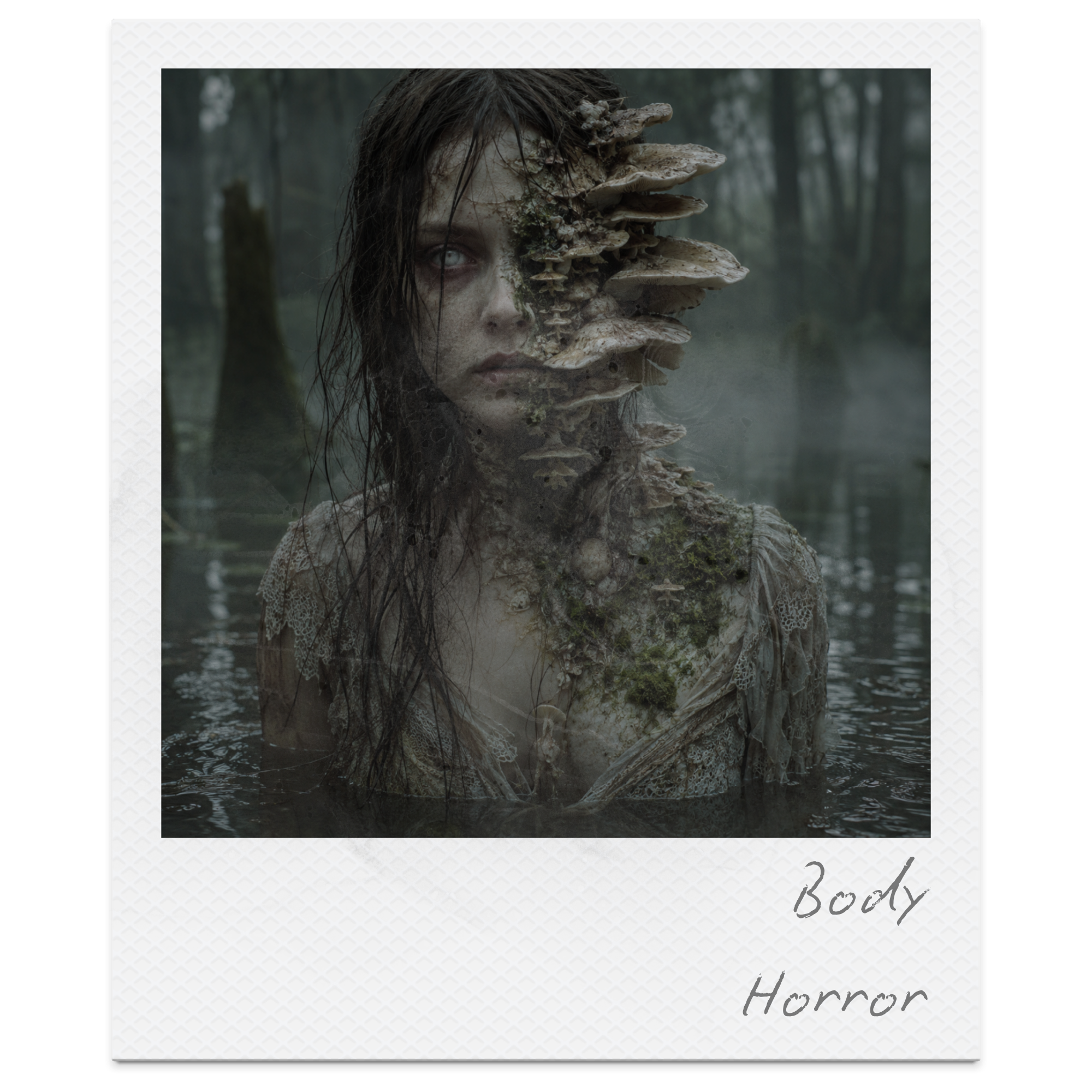
For darker inspiration, explore Body Horror Writing Prompts, 100 Body Horror Novel Ideas and the Body Horror Disease Generator, which can help you develop fictional infections, experimental conditions, disturbing symptoms and transformations.
Try this: Invent a medical treatment that appears successful at first. What unexpected change begins to emerge, and why might the patient eventually wish they had never been cured?
3. Make the Hospital's History Part of the Mystery
An abandoned hospital should feel as though it existed long before your protagonist arrived. Its previous patients, staff, treatments, scandals and closures can all provide layers of mystery that gradually reshape the story.
Rather than explaining the institution's history immediately, reveal it through physical evidence: incomplete patient files, damaged photographs, handwritten treatment notes, newspaper clippings, staff correspondence or recordings recovered from forgotten wards.
These fragments can contradict one another, creating uncertainty about what actually happened.
Perhaps the official records claim that a children's ward closed after a fire, while photographs show patients receiving treatment years later. Or a doctor's journal describes a successful experiment that hospital administrators insist never took place.
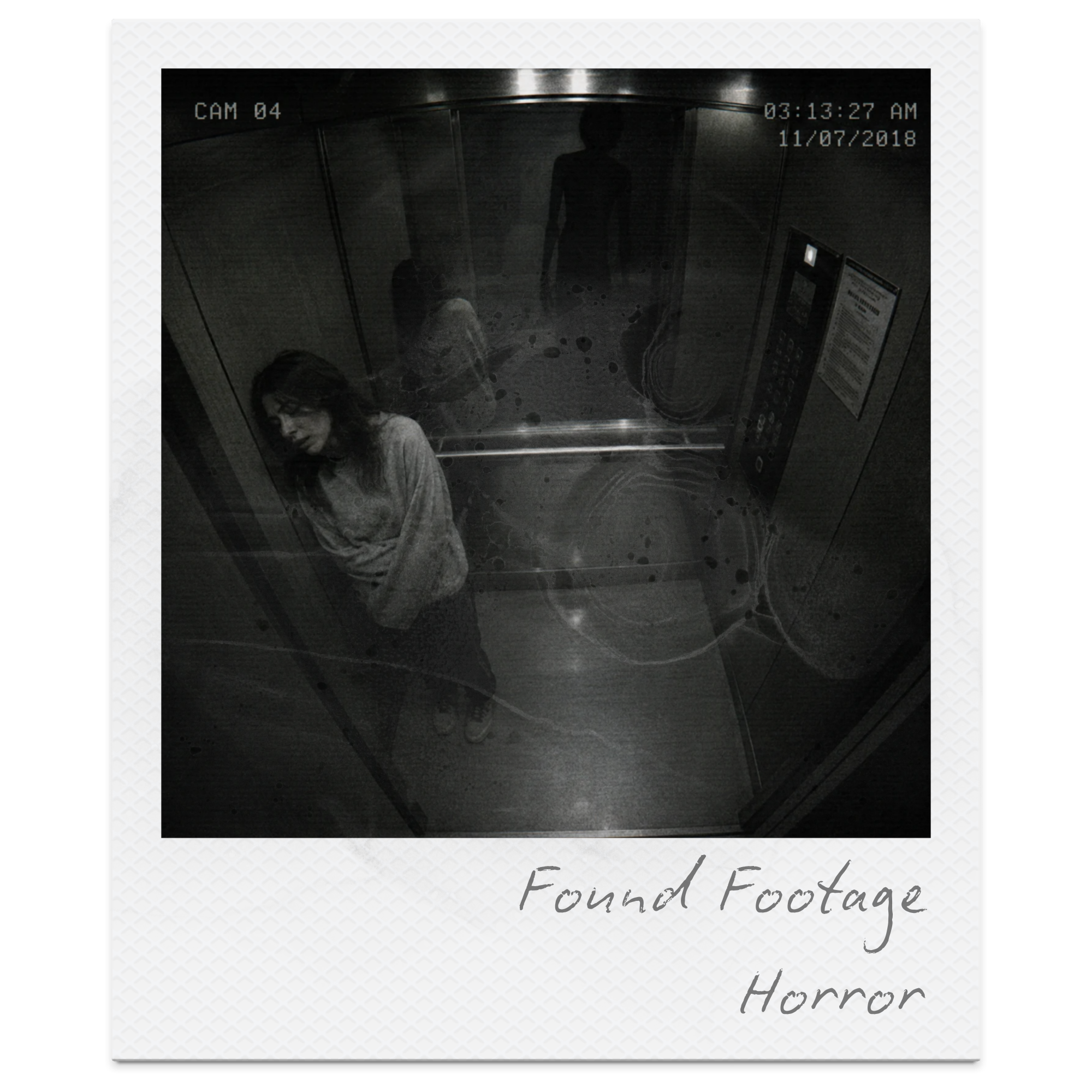
This approach is particularly effective in Found Footage Horror, where recovered recordings, surveillance tapes and fragmented evidence allow readers to investigate the mystery alongside the characters.
Try this: Write three documents relating to the same hospital incident: an official report, a patient's diary entry and a private letter written by a member of staff. What crucial detail changes between the accounts?
4. Create Psychological Dread Through Unreliable Perception
Not every abandoned hospital needs a ghost, monster or supernatural explanation. Sometimes the most frightening possibility is that the protagonist can no longer trust their own memories or senses.
A character might recognise rooms they have never visited, remember undergoing procedures that supposedly never happened, or discover evidence suggesting they were once a patient at the institution.
Medical environments offer particularly effective opportunities to explore memory manipulation, experimental psychology, hallucinations and the unsettling possibility that someone's identity has been deliberately altered.
Consider a protagonist who finds their name on a patient register, complete with photographs showing them at different ages. Are the records genuine? Has someone fabricated their history? Or have they forgotten something so traumatic that their mind has constructed an entirely different life?
The strongest psychological horror maintains uncertainty while gradually increasing the consequences of the character's discoveries.
Try this: Give your protagonist one memory they consider absolutely reliable. What could they discover inside the hospital that makes them question whether it ever happened?
5. Use Sensory Details to Make the Hospital Feel Alive
Atmosphere is essential to abandoned hospital horror. Instead of relying exclusively on darkness, silence and cobwebs, consider the distinctive sensory details associated with neglected medical environments.
The sharp smell of antiseptic might linger beneath damp plaster. Water could drip into stainless-steel surgical trays, producing irregular metallic echoes. Peeling vinyl flooring might cling to a character's shoes, while faded curtains shift in a draught from an unseen ventilation shaft.
You can also create unease by introducing details that do not belong.
A recently polished operating table inside a ruined theatre, the warmth of a hospital bed in an otherwise freezing ward, or the unmistakable smell of fresh coffee drifting from an abandoned staffroom can suggest that someone has been there recently.
The contrast between decay and unexpected signs of occupation is often more disturbing than an obviously supernatural encounter.
Try this: Describe an abandoned operating theatre using five sensory details, but introduce one element that suggests the room was used only moments earlier. Do not explain who used it or why.
For additional atmospheric inspiration, explore Gothic Horror Writing Prompts and Abandoned Places Writing Prompts to experiment with decay, isolation, architectural detail and unsettling environments.
6. Use Isolation, Architecture and Restricted Spaces to Build Suspense
Hospital buildings are often large, confusing and filled with corridors, stairwells, locked wards, underground service passages and interconnected treatment rooms. These architectural features can become essential parts of your horror story.
A character might discover that every staircase leads back to the same floor, that an emergency exit opens into a sealed operating theatre, or that the hospital's architectural plans omit an entire wing.
However, effective suspense depends on more than trapping characters inside a frightening building. The environment should create meaningful obstacles and force increasingly difficult decisions.
Perhaps the only route to safety passes through a contaminated isolation ward. A missing person might be trapped somewhere beneath the hospital, forcing the protagonist to choose between escaping and continuing the search.
Establish the geography of your setting early enough that readers understand the danger when familiar routes become inaccessible.
Try this: Draw a simple map of your abandoned hospital, including three possible exits. Then introduce a different obstacle that makes each escape route dangerous.
7. Give Your Hospital Horror a Distinctive Threat
An abandoned hospital can contain almost any type of horror, but the central threat should feel connected to the institution's history, purpose or medical practices.
A supernatural entity might imitate the voices of former patients. A biological experiment could have survived inside the hospital's water supply. An artificial intelligence system designed to monitor patients might continue enforcing treatment protocols decades after the building closed.
You could also explore a threat that initially appears beneficial.
What if a mysterious surgeon could cure any illness, but demanded something far more valuable than money? What if a hospital's experimental treatment genuinely eliminated pain, while gradually destroying the patient's ability to experience other emotions?
The strongest threats often have understandable rules, limitations or patterns that characters can investigate, exploit or misunderstand.
Try this: Invent a threat that could exist only inside your abandoned hospital. What does it want, how does it operate, and what happens when someone discovers its rules?
For further inspiration, explore Sci-Fi Horror Writing Prompts for technological and experimental threats, or Ghost Story Titles for supernatural mysteries involving restless spirits and forgotten institutions.
8. Make the Final Revelation Change Everything
A memorable hospital horror ending should do more than reveal a monster or allow the protagonist to escape. Ideally, it should transform the reader's understanding of something established earlier in the story.
Perhaps the abandoned hospital was never designed to treat human patients. The protagonist might discover that the building itself was part of an experiment, or that the people they believed were doctors were actually patients attempting to recreate their former lives.
A final revelation becomes particularly effective when earlier details suddenly acquire new significance.
The repeated sound of a hospital bell, the absence of mirrors in patient rooms or the strange wording of a discharge certificate might initially seem insignificant, only to become essential to understanding the truth.
You can also create an unsettling ending by leaving one carefully chosen question unanswered.
The protagonist might escape the hospital, only to discover that their medical bracelet has appeared on someone else's wrist.
Try this: Choose one ordinary detail from the beginning of your story and give it a horrifying new meaning in the final paragraph.
Turning Your Abandoned Hospital Prompt into a Complete Horror Story
Once you've chosen a plot hook, character, setting or visual prompt, begin developing your story by answering five questions:
Who enters the hospital, and why? Give your protagonist a compelling reason to investigate rather than simply wandering into danger.
What is the first sign that something is wrong? Introduce an unsettling detail that challenges their expectations without immediately revealing the threat.
What happened inside the hospital? Develop a hidden history involving patients, medical staff, experiments, institutional secrets or unexplained events.
What makes escape increasingly difficult? Use physical obstacles, psychological uncertainty, personal connections or escalating danger to raise the stakes.
What terrible truth will the protagonist uncover? Decide how the final discovery changes their understanding of the hospital, themselves or the world beyond its walls.
You don't need to answer every question before writing. Sometimes the most compelling horror stories emerge when a seemingly simple discovery leads somewhere completely unexpected.
If you're still searching for your next disturbing idea, experiment with Horror Story Sparks, explore Horror Opening Lines for an atmospheric beginning, or browse the Horror Writing Hub for more characters, settings, story concepts and creative writing inspiration.
The hospital might be abandoned, but that doesn't mean its story is over.
Final Thoughts: The Horror That Never Left the Hospital
Abandoned hospitals are among the most unsettling settings in horror fiction because they occupy the disturbing space between healing and suffering, scientific discovery and human experimentation, life and death. Their deserted corridors, forgotten patient records, decaying operating theatres and sealed psychiatric wards offer endless opportunities to explore the secrets that institutions leave behind and the terrible consequences of uncovering them.
These 70 Abandoned Hospital Horror Writing Prompts are designed to take you beyond familiar haunted-hospital clichés and encourage more imaginative, psychologically disturbing and atmospheric storytelling. From sinister medical experiments and impossible diagnoses to missing patients, unreliable memories, supernatural encounters and horrifying discoveries, each prompt offers a different starting point for developing original horror fiction.
Whether you're writing a short ghost story, planning a psychological horror novel, experimenting with body horror or creating a dark mystery rooted in medical history, remember that the most effective horror often begins with a single unanswered question. A patient file that should not exist. An operating theatre that has recently been used. A voice calling from a ward that was sealed decades ago.
You don't need to reveal every secret or explain every terrifying discovery. Sometimes the stories that linger longest are those that leave readers wondering what else might be hidden behind the hospital's locked doors.
For more unsettling inspiration, explore the Horror Writing Hub, where you'll find disturbing story ideas, sinister characters, atmospheric settings, supernatural mysteries and resources for developing your own horror fiction. You can also experiment with Horror Story Sparks for unexpected combinations of characters, threats and terrifying discoveries, or browse the Creative Writing Archive for hundreds of additional writing prompts across horror, Gothic fiction, mystery, fantasy and beyond.
Every abandoned hospital has a history. Every locked ward has a story. And some patients were never meant to leave.
The question is whether your characters will.
Choose Your Next Adventure